Mariah Carey entered 1999 with a commercial record that already looked unreal in real time: 14 national chart number-one singles between August 1990 and March 1999. That is the only sensible place to begin the Rainbow-era archive, because the press coverage does not make sense if the baseline is merely fame.
She was not trying to become visible. She was trying to stay free while remaining unavoidable.
What's Inside
- A Career at the Absolute Pinnacle
- Criteria for Selection: Archiving the 1999 Press Tour
- The Hip-Hop Evolution of 'Heartbreaker'
- 'Petals' and the Autobiographical Shift
- The 'Bachelor' Cameo and Stunt Double Refusal
- The Genesis of 'All That Glitters'
- Collaborating with Jimmy Jam & Terry Lewis
- 'Can't Take That Away' and Social Consciousness
- Bibliography
A Career at the Absolute Pinnacle
The late-1990s Mariah Carey profile often begins with glamour: the hair, the gowns, the candy-colored videos, the sudden feeling that every frame had been saturated on purpose. The archive points somewhere sharper. Rainbow was a survival text dressed as a pop event.
The public transition after the finalization of her 1998 divorce from a former label executive lasted roughly a year, and the press tour pushed its message across six major international markets. That matters. The album title was not just a bright object for retail shelves; it gave reporters a convenient metaphor for the storm that came before it.
The tension is visible in nearly every 1999 interview. Carey wanted to protect the chart machinery that had made her the dominant recording artist of the decade, but she also wanted authorship over the room, the collaborators, the styling, and the story.
Bottom Line: Rainbow is best read as a transition document: commercial dominance on one side, personal autonomy on the other.
Criteria for Selection: Archiving the 1999 Press Tour
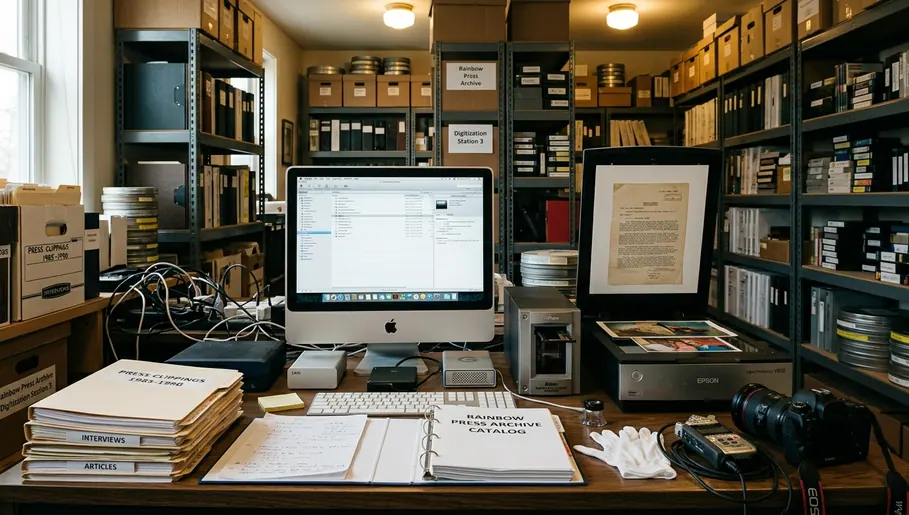
For this archive pass, I initially considered broadcast television transcripts, then ruled them out. The selected file focuses on print features published between September 15, 1999, and December 20, 1999, drawn from four distinct international magazine cover stories: Jane, FHM, Touch, and Vogue Spain.
That narrower field gives the material a useful pressure. Lifestyle and fashion magazines in 1999 did not ask the same questions as audio engineering publications, and their editorial slant can soften the technical musical discourse. Still, they caught a transitional window that studio notes alone would miss: the public language of freedom, the acting plans, the guest-heavy sound, and the visible rebalancing of image control.
The selection criteria were simple:
- Publication timing: only print features from the active late-1999 Rainbow campaign.
- International spread: magazines that show how the era was explained outside a single national press system.
- Career transition value: interviews that address music, film, and autonomy in the same frame.
- Source clarity: pieces with identifiable issue context, byline trail, or archiveable publication data.
Failure to contextualize the 1999 press tour within her broader label disputes leaves only the surface: a pink tank top, a bright album cover, and a few famous cameos. The archive has to hold the tension underneath.
1. The Hip-Hop Evolution of 'Heartbreaker'
'Heartbreaker' did not simply add a rap feature to a pop single. It organized a room around pop, R& B, and hip-hop as shared architecture.
Josh Rottenberg's coverage of the late-August 1999 mixing sessions is valuable because it does not treat the guests as decorative names. The track's final cut integrated five distinct guest vocalists: Jay-Z, Snoop, Da Brat, Missy, and DJ Clue. Across a documented 48-hour mixing period, the single reads less like a crossover experiment and more like a controlled handoff between formats.
That distinction matters for Carey. Her earlier remixes had already built serious credibility with club and R& B audiences, but 'Heartbreaker' placed the strategy directly into the lead-single position. The pop hook stayed polished. The guest roster brought a different charge.
Field Note: The interpretation of her hip-hop collaborations changes depending on whether the analysis starts with pop radio reach or urban contemporary performance.
The result was not a rejection of the ballad singer. It was a more public version of the producer, editor, and collaborator she had been becoming.
2. 'Petals' and the Autobiographical Shift
'Petals' lasts 2 minutes and 23 seconds, which is part of its force. It does not sprawl. It arrives, names the wound, and leaves the room quiet.
The track came out of a three-week writing retreat in early 1999, and its subject matter sits far from the usual promotional shorthand of heartbreak. Carey turns toward family, estrangement, and relationships that had stopped moving. The writing feels private without becoming vague.
Placed beside the David Foster-produced ballads on the same album, 'Petals' shows a deliberate split in the project's design. One side preserves the grand vocal tradition that had powered much of her 1990s catalogue. The other side lets the lyric narrow into autobiography.
That contrast is the key. Rainbow does not abandon traditional balladry; it places those ballads beside a song that sounds like an entry pulled from a sealed envelope. The guarded distance of earlier themes gives way to something more direct, less buffered by romantic universality.
3. The 'Bachelor' Cameo and Stunt Double Refusal
The film debut in The Bachelor put Carey opposite Chris O'Donnell in a cameo that could have been treated as a novelty. Instead, it carries one of the stranger and more revealing details of the 1999 archive.
She played a psychopathic opera singer, a comic twist with a biographical echo: her mother, Patricia Carey, was an opera singer. The role let Mariah brush against that lineage while exaggerating it into farce. It is brief, but not blank.
The production included a 3-second on-screen fall sequence filmed in mid-1999. A stunt double was offered. One specific double was dismissed directly on the set, and Carey handled the moment herself.
It sounds like a comic aside—until it is placed beside the rest of the year. The physical bit mirrors the larger pattern: she was testing what she could take on without someone else performing the difficult part in her place.
Important: The cameo should not be inflated into a full acting thesis, but it belongs in the chronology because it precedes the Hollywood planning already underway that summer.
4. The Genesis of 'All That Glitters'
'All That Glitters' was the working title attached to Carey's upcoming film project about the 1980s music scene. The title remained in use throughout the initial 18-month development phase, which gives the archive a clear thread from late-1999 press talk to the more public film narrative that followed.
Between June and August 1999, Carey scheduled intensive acting workshops with Sheila Gray. This is the practical part of the chronology: not a singer casually mentioning film, but a recording artist blocking out time for technique before taking a first starring role.
The historical context is worth keeping clean. Pop stars crossing into film were not new in 1999, and the industry often treated those moves as vanity projects before the work had even appeared. Carey's preparation complicates that easy dismissal. She was not only lending a soundtrack voice to a movie idea; she was building a performance vocabulary.
The personal take, after reading the print trail, is that 'All That Glitters' gave the Rainbow interviews a second horizon. The album campaign was immediate. The film project suggested she was already thinking past the release cycle.
5. Collaborating with Jimmy Jam & Terry Lewis
The recruitment of Jimmy Jam and Terry Lewis for Carey's eighth studio album anchored Rainbow in an R& B lineage that was both elegant and firm. Their presence made the album's genre posture harder to dismiss as surface styling.
The most precise example is the Phil Collins cover 'Against All Odds.' The original ballad, released in 1984, arrived with a different emotional grammar: adult-contemporary ache, dramatic restraint, and a melody built to swell. Carey and the production duo reimagined it inside a 14-day studio booking in mid-1999, making room for her vocal architecture without losing the song's recognizable frame.
This is where the album's split personality becomes productive. On one side, 'Heartbreaker' leans into the guest-driven energy of late-1990s hip-hop collaboration. On another, 'Against All Odds' gives the project a classic R& B-ballad foundation shaped by producers whose catalog already carried deep authority.
That pairing does not feel accidental. It is the sound of an artist making the album broad without making it vague.
6. 'Can't Take That Away' and Social Consciousness
'Can't Take That Away' occupies a different lane in the Rainbow file. The collaboration with Diane Warren began within 72 hours of the April 1999 national school tragedy at Columbine, and the song functions as a direct lyrical response to a public crisis.
Carey's 1990s discography usually moved through romance, endurance, longing, and self-definition. Those themes could be enormous, but they were often framed through personal address. Here, the writing turns outward.
The track is not journalism, and it does not try to be. Its social consciousness comes through the language of refusal: the self cannot be taken, even when the surrounding culture feels brutal and unstable. In the context of Rainbow, that message aligns with the album's autonomy narrative while reaching beyond Carey's own biographical storyline.
The Diane Warren collaboration also broadens the album's emotional register. It sits near 'Petals' in its seriousness, but its target is different. One song looks into the family system. The other answers a national wound.