The Emancipation of Mimi did not arrive like a polite course correction. It arrived like a door being kicked open from the inside.
By 2005, Mariah Carey was not fighting for name recognition. She was fighting for authorship: over her sound, her public story, and the way the industry talked about a recording artist whose gifts had become too easy to flatten into tabloid shorthand. That is why this album still feels combustible. It was not only a commercial rebound. It was a creative argument with hooks, melisma, bass, breath, and nerve.
The Weight of 2005: A Career at the Crossroads
Pop had moved, and Mariah moved with intent
The early 2000s were brutal terrain for legacy pop stars. Radio tightened. Hip-hop and R& B had redrawn the center of mainstream taste. Adult contemporary ballads still had room, but they no longer carried the same cultural heat.
That shift mattered because Mariah Carey could have been pushed back into the safest version of herself: grand ballads, polished arrangements, a familiar vocal showcase. Instead, the artist and her management team weighed the changing pop landscape and ruled out a retreat to adult contemporary comfort. The move was toward a more authentic R& B language, not away from pop ambition.
The pressure around the album was not abstract. It sat on every decision: first single, vocal tone, collaborators, visual styling, interview posture. Carey needed a record that could move through radio without sounding like a plea for approval.

The April 2005 issue of Newsweek Magazine captured the stakes with unusual clarity. Carey spoke candidly about mindset and the need to take creative control at a moment when the narrative around her career had become louder than the music. The important part is not that a magazine validated the comeback. It is that the interview showed the comeback had a thesis.
Bottom Line: The album worked because it did not ask listeners to forget the previous years. It made the music strong enough that the previous years stopped leading the conversation.
The problem was perception; the solution was authorship
Here is the hinge: The Emancipation of Mimi did not deny Mariah Carey’s pop history. It reorganized it. The whistle tones, stacked backgrounds, conversational phrasing, gospel pressure, and hip-hop fluency all had precedent in her catalog, but this era made them feel newly centralized.
That is why the title matters. “Mimi” was not just branding. It gave the public a name for the less airbrushed, more rhythmic, more socially fluent version of Carey that had always been present in the work.
Crafting the Comeback: Inside the Studio Sessions
Live feel, digital pressure
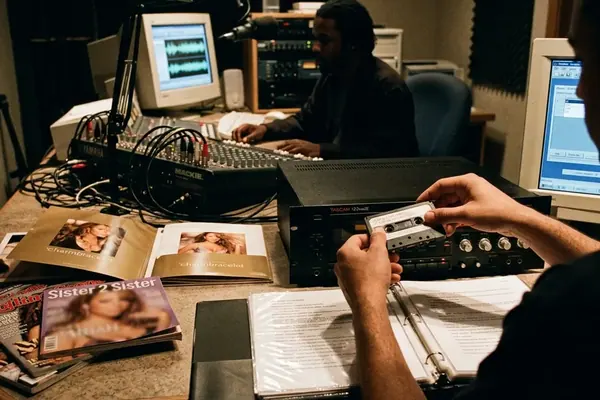
The studio story behind this Mariah Carey album is not a sterile tale of hitmaking by committee. It is a story of friction between live instrumentation and digital beat-making, with Carey sitting at the center of the architecture.
From August 2004 through February 2005, the recording phase leaned into hip-hop and R& B elements while preserving the elasticity of a singer who treats harmony like infrastructure. Fan archive documentation has tracked many of the session details and credit trails, though that kind of documentation is best used for sequencing public credits and dates, not for claiming access to private studio intent.
What comes through anyway is the hands-on nature of the work. Carey was not simply arriving to sing finished tracks. She was a Writer and Producer shaping vocal arrangements, background stacks, phrasing, and the emotional temperature of the record.
James Wright and the slow-burn vocal showcase
James Wright’s role as Writer and Producer becomes especially important on “I Wish You Knew.” The song does not chase the obvious release of a giant chorus from the first bar. It builds like a club performance heard from a few feet away: intimate, smoky, controlled, and then suddenly open-throated.
That track is a useful key to the whole album. The comeback was not built only on speed, bounce, or radio immediacy. It also needed spaces where Carey could remind people that vocal arrangement is composition. A riff is not decoration when it changes the emotional meaning of the line.

I keep coming back to the backgrounds on this record because they do so much quiet labor. They answer the lead vocal. They thicken a phrase before the beat drops. They make a hook feel communal without blurring the identity of the singer at the center.
- Vocals as structure: Carey’s lead lines and background parts often behave like interlocking instruments.
- Production as framing: Digital drums give the record urgency without stripping out warmth.
- Collaboration as focus: The best contributions sharpen the Mimi persona rather than crowd it.
Attempts to replicate this comeback blueprint often stall when the artist lacks the foundational songwriting credits to command absolute studio authority. That is the part people miss when they reduce the era to timing. Timing helped. Control mattered more.
The Ripple Effect: Setting the Standard for Future Eras
The rollout became a template
The success of The Emancipation of Mimi gave future Carey projects a usable map: establish a clear sonic identity, stage the single campaign with precision, then let the album arrive while the public conversation is already moving.
That structure became especially visible when comparing the 2005 rollout with the Memoirs of An Imperfect Angel era. By 2009, the industry had become more schedule-conscious around radio setup, retail timing, and digital chatter. The campaign for Memoirs used a September 2009 radio impact date roughly two weeks ahead of the album release, creating a short promotional window.
What a radio impact date actually does
A radio impact date is the scheduled day a song is officially promoted to radio stations for airplay. It does not mean no one has heard the track before then. It means the label is coordinating the push: programmers, formats, callout expectations, interviews, and the first wave of measurable airplay momentum.
For an established artist, that buffer can create urgency. For a newer act, the same window can be too tight to build recognition. The effectiveness of a two-week radio-to-retail window fluctuates heavily based on the specific genre’s reliance on streaming algorithms versus traditional terrestrial airplay.
Important: The short pipeline made more sense for a legacy artist with guaranteed mainstream airplay than it would for an unknown singer still trying to earn format trust.
That is the lesson Mimi left behind for future eras: a rollout is not just a calendar. It is a pressure system. If the song, image, interviews, and audience memory do not push in the same direction, the dates are just dates.
- Lead with a single that clarifies the era’s sound.
- Give radio enough time to convert curiosity into repetition.
- Keep the album close enough that momentum does not leak away.
- Match the visual language to the emotional claim of the music.
Beyond the Music: Building a Multimedia Empire
Mimi became a marketable identity
The album’s success did not stay inside traditional music lanes. Once Mimi became legible as a persona, it could travel.
The launch of the M by Mariah Carey fragrance brand made sense because it extended the softness, glamour, and intimacy of the era without pretending to be a song. This was not random celebrity licensing pasted onto a hit album. It was lifestyle translation: the same public who had re-entered Carey’s world through voice and vulnerability could now buy an object tied to that mood.
That distinction matters. A fragrance connected to Mimi worked because the era already had texture. It had lighting, hair, language, humor, and emotional cues. The brand extension did not have to invent a universe from scratch.
Digital distribution was still physical in spirit
The multimedia strategy also shows how transitional the mid-2000s were. The BET Testimony interview circulated as downloadable MPG video, a format that now feels like a fossil from the broadband threshold. Yet at the time, that kind of file mattered. It let fans keep the interview, trade it, archive it, and replay the public explanation of the era outside a broadcast schedule.
Across 2006 and 2007, the broader branding and media activity around Carey’s catalog kept legacy assets in motion. The September 2007 reissue of a classic acoustic performance catalog fits that pattern: renewed attention around Mimi made older material newly useful, not as nostalgia alone but as proof of continuity.
Field Note: The smartest post-Mimi moves did not treat the album as a one-off spike. They treated it as a hub that could send listeners backward into the catalog and outward into lifestyle media.
That is how a comeback becomes bigger than a comeback. It stops being one album rescuing a career and becomes a system for re-reading the entire career.
The Enduring Legacy of Mimi
The album changed the argument
The lasting impact of The Emancipation of Mimi sits at the intersection of pop memory and R& B craft. It gave Carey one of the defining mainstream runs of the decade, including a 14-week consecutive stretch at the top of the domestic singles chart. More important, it made the industry adjust to her rather than the other way around.
That is the core of the legacy. The album did not sand down her musical instincts to fit the moment. It found the part of the moment that was already speaking her language: hip-hop cadences, R& B warmth, gospel release, club confidence, and pop-scale melody.
Retrospective readings of the project often focus on the comeback narrative because it is clean and dramatic. I get the appeal. But the better story is less tidy: Carey reclaimed the terms of her own presentation by making the songs carry the argument first.
Why it still plays like a current record
The album endures because its confidence is musical, not just promotional. The hooks still move. The vocal stacks still teach. The singles still understand how vulnerability and dominance can occupy the same four minutes.
For pop and R& B, Mimi set a high bar for the adult superstar reset: do not chase youth, do not flee history, and do not confuse reinvention with disguise. Carey sounded refreshed because she sounded more specifically like herself.
Does The Emancipation of Mimi stand as the greatest comeback album in modern pop history, or simply the moment Mariah Carey finally forced the industry to meet her true self?