Start Where Mariah Carey Learned to Look Beyond the Suburbs
The Empire State Building makes a spectacular Mariah Carey photograph. Greenlawn, Long Island, tells a better story.
Carey’s New York landmarks trace a journey from suburban adolescence to recording studios, a Harlem stage, a TriBeCa home and a skyline known around the world. The tempting way to tour them is to start with the glamour. Start instead with the place she wanted to leave. The distance between Greenlawn and Manhattan helps explain the ambition and escapism that run through her early work.
Those high school years also cut through the familiar diva shorthand. Before the penthouse and ceremonial lightings, there was a young recording artist balancing school with time in studios, already reaching toward a life that seemed far away. Family complexity and suburban isolation form part of that story; neither needs a dramatic address or a fan legend to make it compelling.
This itinerary follows places with a documented connection to Carey. It also asks visitors to notice what has changed. A school remains a school, a studio has vanished, and a famous home remains private. Treat the trip as a walk through her history rather than a hunt for access.
Greenlawn and the Harborfields Hallways
Harborfields High School is the essential first stop. During her Greenlawn years, Carey’s frequent absences for studio sessions earned her the nickname “Mirage.” It is an affectionate bit of fan history, but it also gives the school a clear place in her story: she was trying to make music while still expected to show up for class.
Picture the journey back from a session to an ordinary school day. That pull between the life at hand and the life she imagined lends useful context to the escapism on her debut album. The songs can be heard as the work of someone whose ambitions had already carried her well beyond her daily surroundings, even while she was living inside them.
Greenlawn rewards a slower visit than a quick photograph. Walk its public streets, take in the scale of the neighborhood and then approach the school only from a public sidewalk. The building is an active educational facility. Keep entrances clear, leave students and staff alone, and never enter the grounds for a closer view. An after-school visit can reduce disruption, though the public-sidewalk boundary still applies.
There is a useful limit to the map. The school-era connection is the reliable geographic anchor here; exact earlier childhood residential addresses remain unverified in the material used for this itinerary. Skip any online route that claims to lead you to a private childhood doorstep. Harborfields and its surrounding streets give you enough to understand the setting without turning someone’s home into a destination.
Give Greenlawn the unhurried part of your day. Manhattan’s stops are easier to recognize, but this is where the scale of Carey’s ambition comes into focus.
What Remains of Sony Music Studios on West 54th Street
At 460 W. 54th Street, the landmark is an absence. Sony Music Studios once stood here in Hell’s Kitchen; the original facility was demolished and luxury condominiums took its place. Visitors looking for the room where Carey performed will find a changed streetscape instead.
That change makes the address worth seeking out. Carey’s 1992 MTV Unplugged performance was filmed at the studio, and recordings associated with Music Box and Daydream give the site a place in the story of her early hits. Unplugged, in particular, preserved a live performance at a moment when her voice was under intense public scrutiny. The broadcast remains; its physical setting does not.
Stand along the public sidewalk and look at the block rather than searching for a surviving studio entrance. The former facility’s footprint can be placed against today’s development, but the old recording rooms cannot be visited. Give yourself a moment with that mismatch. New York regularly builds over its pop history, and a precise address can still carry meaning after the walls are gone.
This stop works especially well after Greenlawn. There, a school building helps you picture the start of her effort. On West 54th Street, a vanished workplace asks you to supply the sound from memory: the close attention of a live room, the pressure of the cameras and Carey’s voice meeting both.
The Apollo Stage That Put Her Voice to the Test
Head uptown to Harlem’s Apollo Theater for a venue whose significance is easier to see from the street. Carey’s early 1990 showcase here put her in front of a demanding industry audience at a crucial point in her rise. A polished recording could introduce a new singer; a performance on this stage gave listeners a chance to hear what she could do live.
The Apollo also places her pop breakthrough in a wider musical setting. Carey’s vocal approach draws deeply from R&B and gospel traditions, and this theater gives those roots a physical presence on the itinerary. Pause at the exterior, look at the marquee and imagine the stakes of walking into that hall before the scale of her success was clear.
For background on the venue itself, the Apollo Theater's historical archives offer a useful companion to the visit. Check the theater’s current visitor information before planning around an interior tour; the exterior is the dependable stop on this route.
The contrast with the former Sony site is striking. One performance space has been replaced, while the other still anchors a neighborhood’s musical identity. Together, they keep the focus on performance rather than celebrity scenery.
Franklin Street and the TriBeCa Dream
By the time Carey’s TriBeCa penthouse appeared on MTV Cribs, the apartment had become part of her public image. Fans saw the confidence, humor and luxury of an artist whose childhood dreams had become visible on a grand scale. A walk along Franklin Street brings that familiar television image back into the everyday rhythm of downtown Manhattan.
Keep this stop brief and exterior-only. The building is a private residence, and a fan itinerary gives no one a reason to approach its entrance, wait for occupants or photograph through windows. Enjoy the street’s architecture and the surrounding neighborhood from public space. Then move on.
There is plenty to take in without crossing a boundary. TriBeCa’s substantial facades and quieter side streets create a different mood from West 54th Street’s recording history or Harlem’s theater frontage. Here, the interest lies in what the neighborhood came to represent: a place to live after years spent imagining a larger future.
That progression is more affecting when Greenlawn comes first. The penthouse is a remarkable destination in Carey’s story, but the earlier streets explain why reaching it mattered.
Finish at the Empire State Building, Then Remember Greenlawn
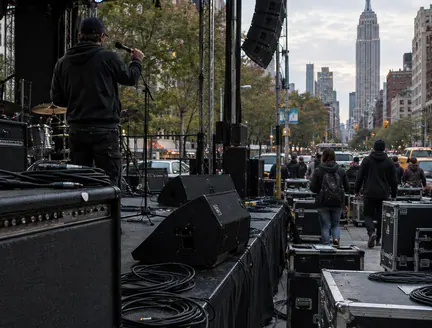
The Empire State Building supplies the itinerary’s unmistakable finale. Carey has taken part in ceremonial lightings there, and the building appeared in the video for “Touch My Body.” It is a fitting symbol for a career that grew large enough to meet New York’s most recognizable skyline.
See it from street level before deciding whether to go up. From below, the building belongs to the city around it: traffic, pedestrians and a tower that keeps drawing eyes upward. After the suburban streets, the lost studio, the Apollo and TriBeCa, that view carries more than a postcard image. It shows the distance traveled.
It also makes the route’s central choice clear. The tower celebrates success; Greenlawn helps explain the drive behind it. Fans with limited time may find a Manhattan-only tour convenient, but convenience misses the strongest part of this story.
If you can make only one deliberate detour, make it Greenlawn. Visit Harborfields from the public sidewalk, spend time in the neighborhood, and let the Empire State Building be the finale rather than the whole story.