What's Inside
- Lead Phrasing Locked to a Low-End Bed
- Air a Phone Speaker Never Moves
- Wired Cups Against a Nearfield Triangle
- Rhythm, Then Harmony, Then the Lead
- The First Play Waits for Dedicated Hardware
Lead Phrasing Locked to a Low-End Bed
A Mariah Carey studio vocal arrangement is an interlocking architecture of lead phrasing, whispered counter-melodies, multi-tracked background harmonies, and precise low-end rhythmic support. I hear that architecture as a construction sequence, and I judge a new single by whether the sequence survives playback.
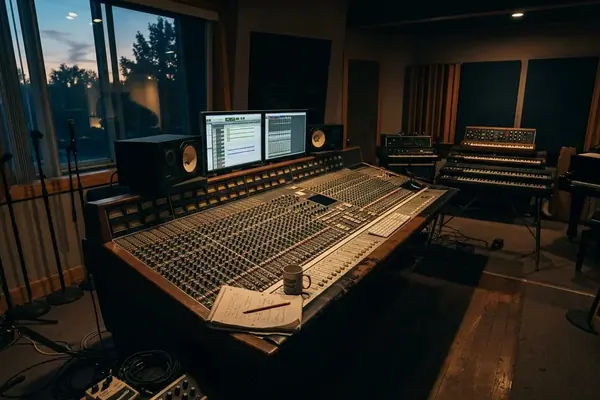
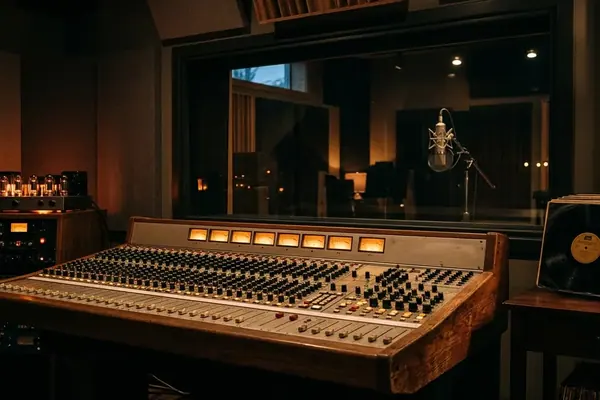
Tracking builds from the floor of the mix. The kick drum and the sub-bass line lock first. The dry lead take follows. Harmonic layers go on only after that lead is stable: typically 8 to 16 separate background vocal tracks during studio practice, grouped into three-part and four-part harmony buses, panned between 35 degrees and 90 degrees left and right. Those buses are collaborations inside the vocal booth, lead against stacked doubles, each with its own pan and its own breath.
That is the object sitting in the file on release morning.
I count the first 15 to 45 minutes after a midnight global window as the stretch when immediate catalog streaming reactions mostly arrive. The phone is already in the hand. Latest news alerts are still on the screen. Playback starts because it is easy, and a smartphone transducer reduces the multi-track production to a narrow midrange signal. The play still posts to discography & charts. Acoustic accuracy loses whenever convenience is the only criterion in the room.
Phone Window Cost
Those opening 15 to 45 minutes collect most catalog streaming reactions. A phone speaker in that slot spends the listen on midrange and leaves the low-end lock and the outer harmony buses unheard.
Air a Phone Speaker Never Moves
Handheld micro-drivers cannot move enough air to reproduce sub-bass or the fundamental bass the arrangement was built on. Their low-frequency roll-off is steep below 250 Hz to 300 Hz. Fundamental 808 notes oscillating between 35 Hz and 60 Hz are omitted entirely. The rhythmic support under the vocal, the part locked before the lead was even recorded, disappears before the first chorus.
The top of the spectrum takes a separate hit. Upper-midrange compression and mono summing collapse wide stereo panning toward the center. Whistle-register accents and breathy doubles, fundamentals sitting between 1,500 Hz and 3,200 Hz, sink beneath the primary lead. Sub-250 Hz roll-off and that 1,500 Hz to 3,200 Hz masking share one tiny driver: the foundation drops out, and the signature top gets covered by the vocal it was meant to ornament.
Mobile hardware then flattens what remains. On-board digital signal processors apply multiband look-ahead limiting with attack times between 0.5 milliseconds and 2.0 milliseconds, squeezing crest factor down to a 4 dB to 6 dB window. An intimate verse and a full-choir climax stop reading as different events. Press archives often describe that climax in adjectives. The levels I track are plainer: a whispered opening that belongs near -18 dBFS, and a multi-tracked peak near -3 dBFS. Inside a 4 dB to 6 dB crest window, those two states collapse into one band of loudness.
I want the contrast intact on day one. A flattened climax teaches the ear the wrong song, and the wrong song is what gets replayed out of habit.
Wired Cups Against a Nearfield Triangle
Wireless earbuds leave a critical evaluation. Standard lossy transmission codecs introduce high-frequency phase smearing across layered whistle-register doubles, which is where a dense Carey stack hides its detail. The comparison that holds is wired over-ear headphones against a properly positioned two-channel room system.
Wired over-ears supply analytical precision: pan position, breath noise, and the seam between lead and double. A two-channel pair supplies physical soundstage. Hard-panned background stacks occupy the outer field. Centered low-end percussion stays on the phantom center. Plate reverb tails of 1.8 seconds to 2.4 seconds decay in the air of the room rather than inside a cup.
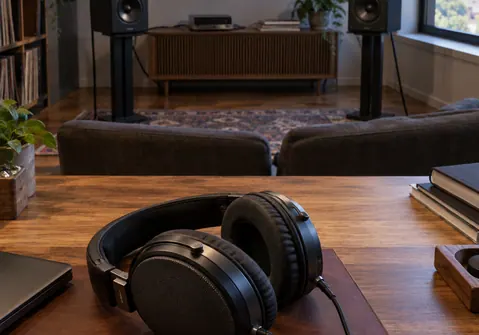
Open-back planar magnetic or dynamic headphones with 40 mm to 50 mm drivers keep total harmonic distortion below 0.1% at something like 90 dB SPL. That headroom matters in a full-choir bridge, where upper-midrange congestion would smear the stacks into the lead. Closed-back cups hold chest resonance against the ear and push vocal sibilance forward; harmonic saturation reads denser and more immediate because the rear wave stays trapped. Open-back designs vent that energy, so saturation spreads and sibilance sits a step back from the ear. For a first pass through this kind of vocal density, I take the open-back pair.
The Triangle That Lets Tails Finish
Nearfield monitors need an equilateral triangle, speakers 1.5 meters to 2.2 meters apart, if those hard-panned stacks and the plate tails are going to finish in physical space. Tours & performances will later push the same arrangement through a PA. Release day is for knowing the studio image before that translation.
In an untreated rectangular room, early lateral wall reflections arrive within 5 to 12 milliseconds of the direct signal and blur dry breathy doubles against wet reverb returns, so the release-day listen moves to wired open-back headphones until that room can hold the image.
Rhythm, Then Harmony, Then the Lead
A surface impression on release day is a reaction. Three focused passes turn that reaction into something you can defend when the track is still in rotation a week later. I separate the software checks from the auditory passes so the ear is grading the master, not a client setting.
Client Settings Before the First Bar
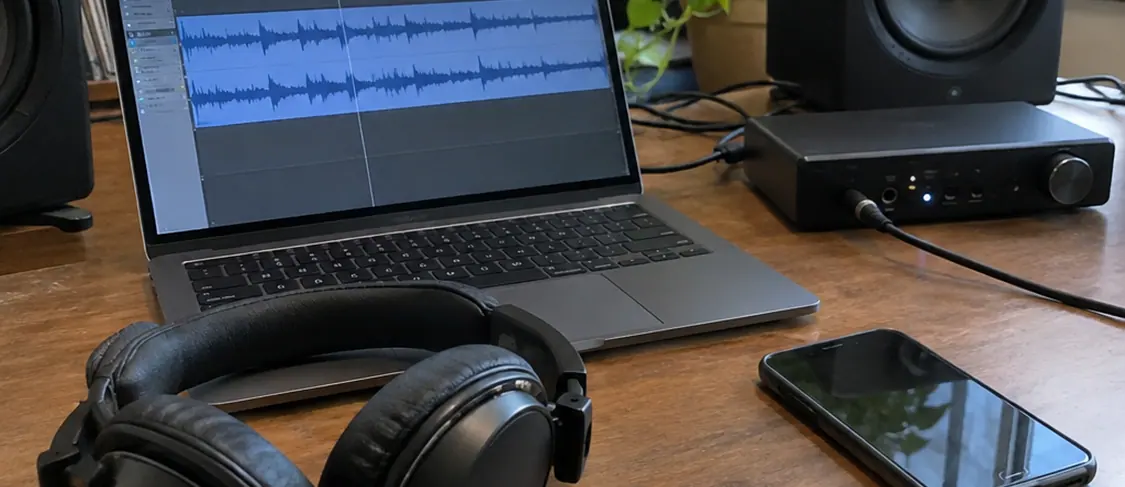
Disable playback volume normalization before you press play. Left on, streaming client algorithms pull the master stereo output down to a -14 LUFS target, more or less, and spend the dynamic transition the mix was built to show. Select a lossless tier over the compressed default so the stream remains an uncompressed 24-bit/48 kHz or 24-bit/96 kHz PCM file. Balance, bass, and treble belong at center. A tilted tone control will invent a low-end problem the master does not contain.
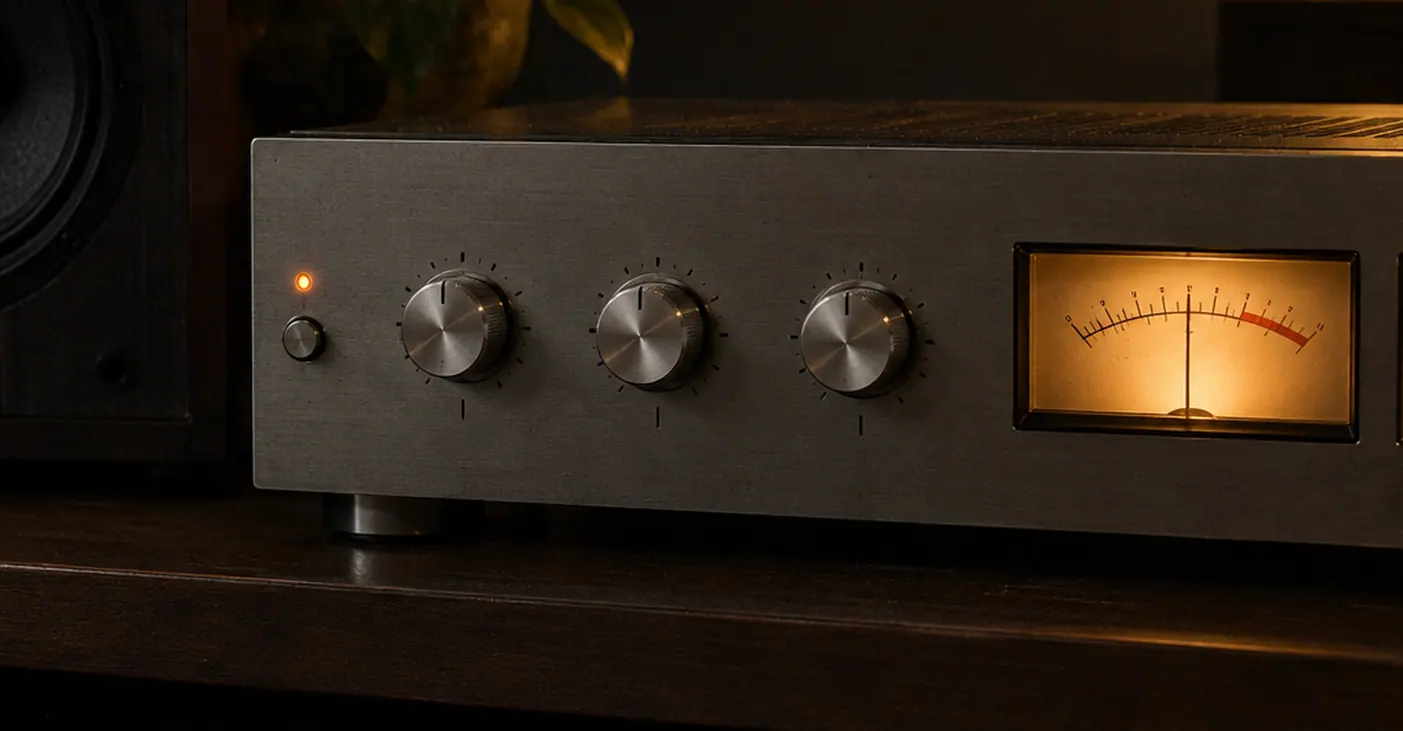
Center The Knobs
Bass, treble, and balance sit at the detent before pass one. The VU needle can dance. The tone controls should not.
Pass One Stays on the Pulse
Pass one is rhythm-section integration and bass articulation, nothing else. Listen for the kick and the 35 Hz to 60 Hz fundamental speaking as one pulse, and for the low end staying centered when the vocal enters. If that fundamental is missing, the hardware is the variable. Opinion about the song waits.
Pass Two Walks the Harmony Buses
Pass two isolates background vocal tracking and harmonic counterpoint. Eight to sixteen stems is a lot of information to skip. Follow one three-part bus, then a four-part bus, and note where each sits between 35 degrees and 90 degrees. Whispered counter-melodies should stay intelligible beside the lead, with their own timing.
Pass Three Follows Timber Through the Climb
Pass three evaluates lead vocal timber and the dynamic transitions. Timber here is the tone of the voice as level changes: chest in the verse, head voice through the climb, whistle-register accents if the arrangement places them between 1,500 Hz and 3,200 Hz. The test is whether the -18 dBFS opening and the -3 dBFS climax feel like two states of the same performance.
A single running 3.5 minutes to 4.5 minutes needs a dedicated 12-minute to 15-minute uninterrupted window for the three passes back to back. I block that window before play. Checking latest news mid-pass resets the ear and wastes the calibration.
The First Play Waits for Dedicated Hardware
How a track behaves across a week of rotation depends on what the first clean listen stored. Instant reaction culture ends when the notification does. Catalog listening continues, and secondary counter-melodies plus ad-libbed harmonic turnarounds are the lines that keep a Carey single in personal rotation. Full-range listening across 20 Hz to 20,000 Hz puts those parts in reach on the first sitting — a compressed chain typically needs 5 to 10 casual listens before they register.
A delay of 30 minutes to 3 hours, long enough to reach wired over-ear headphones or a dedicated digital-to-analog converter, preserves the jump from that whispered opening verse to the multi-tracked climax. The midnight play can wait. The arrangement cannot be reconstructed from a coin-sized driver after the fact.
Hold the first play of a new Mariah Carey release until wired over-ear headphones are on, or you are seated at a dedicated two-channel stereo pair, with lossless playback enabled. That is the listen I trust for the rotation, and it is the only first listen I recommend.