What's Inside
- Why Prioritizing Sequins Over Venue Logistics Ruins the Whistle Register Experience
- Mastering Stadium Security: Clear PVC Totes and Pre-Show Hydration
- Preserving the High Notes: Acoustic Filters and Portable Power Reserves
- Protecting Tour Collectibles and Navigating Outdoor Amphitheater Weather
- The Two-Hour Doors Call: Trimming Weight Before Entering the Queue
Why Prioritizing Sequins Over Venue Logistics Ruins the Whistle Register Experience
Dressing strictly for red-carpet glamour without a concert survival kit is the fastest way to miss Mariah Carey's vocal peaks.
The recording artist still builds a night around the whistle register. That peak arrives late, after ballads, after the crowd has already spent its voice, and after the body has paid for every bad choice made at the hotel mirror. Archive contributors compiling fan entry logs from the 2006 summer amphitheater runs through recent winter tour dates kept seeing the same pattern: a minor wardrobe decision became a major delay at the gate, and the delay landed on the legs before it landed on the setlist.
Modern stadium security is a standing sport. Standard venue queues ask for 45 to 75 minutes of continuous standing on concrete concourses before a fan even reaches the metal detectors. Where the sequined stiletto meets that nearly 75-minute concrete concourse queue, fashion without foldable gel insoles forces fans to sit through the whistle-register climax. The intro has not started. The fatigue has.
Longtime concert archivers place that squeeze in a longer arc. Venue enforcement has tightened from the 2000s amphitheater tours to modern Las Vegas residencies and holiday tour runs. A clutch that sailed through an outdoor shed in the mid-2000s now stops a line cold at a sports complex. A chain strap that photographed well on the carpet becomes a shoulder problem two hours before the opening vocal intro. Fan entry logs compiled by those archivers track what happened at the gate. They do not measure every security team's discretion on a given night, so a bag that cleared one holiday date can still fail the next city's perimeter.
Queue Fatigue TrapOff-site bag check lockers charge $15 to $25 per rejected item and add 30 to 40 minutes to post-show exit times. The sequin look survives the photo. The night does not survive the detour.
Compare two arrivals to the same holiday show date. One fan treats the outfit as the whole plan: stilettos, a designer clutch, a full cosmetic kit, glass fragrance still in the bag. The other treats glamour as the layer that has to fold. Same sequins. Different kit. Only one of them is still on their feet when the upper register opens.
Mastering Stadium Security: Clear PVC Totes and Pre-Show Hydration
North American sports venues drew a hard rectangle and then enforced it. The clear bag is the ticket that never scans, and it fails more outfits than any dress code.
The Clear Crossbody That Actually Clears
Essential 1 is the stadium-approved clear PVC crossbody, cut to the 12 by 6 by 12 inch maximum. Opaque clutches face a 4.5 by 6.5 inch ceiling. Designer minis that look tiny in a mirror often miss that ceiling by a zipper pull or a chain. Security perimeters turn them away. Clear PVC totes sized to the 12-by-6-by-12-inch sports venue standard pass domestic stadium perimeters, while European festival gates and theater residencies apply their own distinct bag measurements. Those grounds frequently restrict all bags to A4 paper proportions, or ban PVC in favor of small woven pouches.
That split matters on a touring calendar. A tote that worked at a U.S. football stadium can be the wrong object entirely at a European outdoor festival or a dedicated theater residency. Read the venue sheet for the city you are actually entering. Pack the bag that city's gate will accept, then stop adding charm charms that push the dimensions over.
Water Before the Ballads, Not During Them
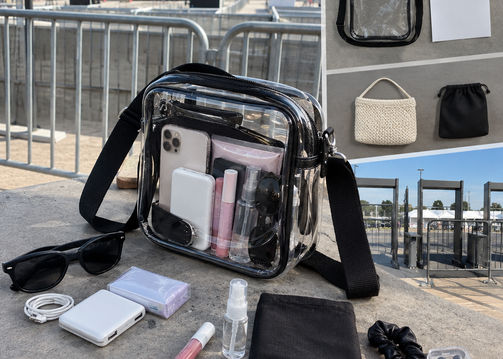
Essential 2 is pre-entry hydration: an approximately 16-ounce electrolyte mix taken 60 to 90 minutes before doors open. The point is vocal stamina across a two-hour setlist, the stretch from "Vision of Love" to "We Belong Together." Singing along to four-octave ballads on a dry throat is how fans lose the night they came to share. Concourse soda later does not rewind that clock. The mix has to be finished before the bag is inspected, because open drinks and mystery packets create their own arguments at the table.
Heels That Can Leave the Feet
Essential 3 is concealed high-density gel insoles, or foldable ballet flats, so sequined stilettos can stay in the look without owning the concrete. Archivers weighed thick platform sneakers as a match for floor-length gowns and ruled them out. Rigid soles cannot fold into a stadium-compliant clear tote when the switch happens at the seat. A platform that cannot collapse is a second pair of shoes you are not allowed to carry. Gel insoles disappear under the insole of the stiletto. Ballet flats roll. Both cross the scanner. The platforms stay in the car.
Fold Before the GateIf the spare shoe will not collapse inside a 12-by-6-by-12-inch tote, it is not a spare. It is a rejected item with a $15 to $25 locker fee attached.
Preserving the High Notes: Acoustic Filters and Portable Power Reserves
The mix booth is a loud neighborhood. Crowd roar and bass bounce smear the very frequencies a lamb came to hear. Audio preservationists compared standard foam plugs against acoustic filters during recent holiday concert runs, listening for scream distortion near the booth and for whether the upper vocal register still cut through.
Filters That Keep the Whistle
Essential 4 is a pair of high-fidelity acoustic earplugs. The filters that held up in those comparisons give a flat 15 to 20 decibel reduction across mid-to-low frequencies while preserving frequencies above 8 kilohertz, where whistle notes sit. Foam plugs quiet the room by dulling it. Filters quiet the roar and leave the top of the voice intact. That difference is the whole reason to spend the money. CDC guidelines on loud noise at entertainment venues describe how entertainment sound levels damage hearing. A filter is how a fan stays for the encore without paying for it in the morning.
Seat location changes the job. Near the mix, bass smear is the enemy. Higher in the bowl, crowd scream dominates. The same flat reduction serves both, which is why preservationists stopped treating foam as a universal fix after those holiday runs.
Power for the Finale, Not the Pre-Show Story
Essential 5 is a high-output portable power bank with a short braided cable already tucked in the clear bag. A 10,000 milliamp-hour pack paired with a 6-inch braided cord sustains continuous 4K at 60 frames-per-second through the 20-to-30-minute encore block and the post-show transit wait. "Hero" and "All I Want for Christmas Is You" are the shots people regret losing. Phones die in the confetti, then die again in the rideshare line. A long cable tangles in a 12-inch-deep tote and snags on security hands. Six inches stays inside the bag and still reaches a phone held at chest height.
One Cloth Against the Fog
Essential 6 is a microfiber lens cloth. Venue humidity and stage fog leave a film on smartphone glass that no amount of digital zoom will fix. Wipe before the finale, not after the photos are already soft. The cloth weighs almost nothing. A ruined encore clip weighs the whole night.
Whistle Band IntactFoam mutes the room. A flat acoustic filter cuts 15 to 20 decibels in the muddy band and leaves everything above 8 kilohertz available. That is the register the night is built on.
Protecting Tour Collectibles and Navigating Outdoor Amphitheater Weather
Merchandise collectors tracked damage patterns on tour books and vinyl sleeves carried through packed concourses. Condensation and beverage spills did more harm than the crush itself. The fix was boring and light: an ultralight water-resistant sleeve already inside the clear bag, ready before the merch table, not after the first splash.
A Second Bag That Lives Inside the First
Essential 7 is a foldable ultralight nylon tote, or a rigid poster tube sleeve, tucked inside the clear bag. Oversized 12-by-16-inch glossy tour books and standard 12-inch vinyl records need a foldable 2-ounce ripstop nylon tote stored in the primary clear bag to shield them from floor spills. White tour tees pick up the same concourse drinks. The nylon stays flat until the purchase happens, then becomes the barrier between a limited pressing and someone else's soda. A tube sleeve does the same job for a poster that will not survive a fold.
Compare that with carrying the tour book bare against the PVC. Clear plastic shows the book to security, which helps. It also shows every drip. The inner sleeve is what keeps The Emancipation of Mimi-era reprints and newer tour books from warping on the ride home.
Two Climates, Two Layers
Essential 8 splits by room. Indoor resident theater venues hold a steady 65 to 68 degree Fahrenheit air conditioning to offset stage lighting rigs. Open-air summer amphitheaters can drop close to 25 degrees between 7:00 PM and 10:30 PM. A mylar wrap or a disposable clear poncho belongs in the amphitheater kit. Breathable layering belongs in the Vegas theater kit. The same sequined dress fails both rooms for opposite reasons: sweat under the rigs, then a chill once the desert night or the shed breeze arrives. Pack the climate of the building you are entering. A poncho in a 68-degree theater is dead weight. A bare shoulder in an amphitheater temperature drop is a missed encore.
A Card the Network Cannot Eat
Essential 9 is a backup physical contactless payment card, kept separate from the phone wallet. Venue terminals drop during intermission rushes. A phone wallet with no signal cannot buy water, a program, or the car exit. The physical card stays in a slim sleeve inside the clear tote, away from the phone, so one dead battery does not also kill the payment method.
The Two-Hour Doors Call: Trimming Weight Before Entering the Queue
Veteran concertgoers instituted a strict two-hour pre-doors bag weigh-in after watching heavy cosmetic kits and metal chain straps wreck shoulders before the opening curtain. The gap between joining the entry queue and the opening vocal intro runs 120 to 150 minutes. Keeping total crossbody bag weight under 2.5 pounds is what keeps that gap from becoming the show.
Run the check in the hotel room, not in the queue. Hold the packed tote. If the strap bites, something leaves.
What Stays Behind the Scanner
Glass perfume atomizers, full-size hairbrushes, and heavy metal wallet chains belong in the hotel room or the vehicle trunk. Leaving them shaves in the range of 1.5 pounds off the carry load and prevents confiscation at security tables. A full bottle of M by Mariah Carey is a dresser object. It is glass, it is weight, and it does not help anyone hear the whistle register. The brush that built the look can stay on the bathroom counter. The chain that photographed well on the carpet is the item most likely to stop the line and bruise the shoulder.
What must cross the ticket scanner is the short list: the compliant clear tote, finished hydration already in the body, foldable footwear or gel insoles, acoustic filters, the power bank with its short cord, the lens cloth, the collapsed nylon sleeve, the climate layer that matches the venue, and the backup card. Everything else is aesthetic freight.
Set the two piles on the bed. Hotel pile on the left. Scanner pile on the right. If the right pile needs two hands to lift, the left pile is not finished.
Will you trade one piece of heavy aesthetic flair in that bag right now to guarantee an uninterrupted view from the opening curtain to the final confetti drop?