What's Inside
- Late Nights, Two Jobs: Butterfly Sessions Meet the Sony Table
- Signing Allure and 7 Mile on a Ninety-Day Clock
- Four Contracts and the 1998 Shutdown Window
- Treat Crave as Carey's First Mogul Blueprint
Late Nights, Two Jobs: Butterfly Sessions Meet the Sony Table
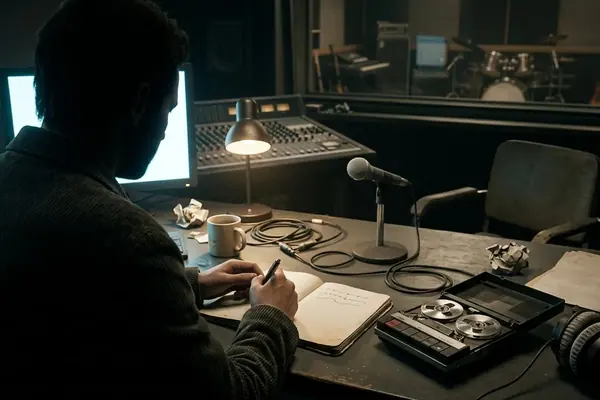
Early 1997. Mariah Carey is still in the booth.
The Butterfly sessions demand something like 14-hour vocal tracking blocks, then she leaves the studio for bi-weekly executive strategy meetings inside Sony Music. Those dual-role weeks pile up from February through August 1997. I treat that stretch as the 1997 vocal-tracking to boardroom-strategy transition matrix: a recording artist building a second job while the first one still required her at full voice.
Why take the A&R grind when she already owned the decade's pop chart?
She wanted industry autonomy. She needed a formal channel for the R&B and hip-hop relationships she had already been cultivating as a writer and featured presence. Chart capital sits in public. Signing power lives in rooms with term sheets. Carey walked into those rooms with hits—and she spent that leverage on control of an imprint.
The meetings carried real contract language. She was learning how a joint-venture desk moves a demo toward radio, how a roster gets budgeted, how an executive defends a baby act when the parent company would rather work a sure thing. That hunger for a seat at the table sits underneath every later catalog run, including the long commercial afterlife of The Emancipation of Mimi.

Butterfly asked her to sound freer. Crave asked her to decide who else got to be heard. Both jobs ran at once, and the calendar did not care which one left her more exhausted.
Signing Allure and 7 Mile on a Ninety-Day Clock
Crave Records arrived as a joint-venture imprint under Sony, a platform built so Carey could sign and develop emerging talent on her own clock. The concept was clean. Put her taste on a roster. Stop waiting for someone else's committee to bless a record she already believed in.
She signed the R&B girl group Allure and the male vocal group 7 Mile. Allure became the flagship. Their debut album used her direct vocal arrangements and co-writing on the lead singles. She wrote, produced, and stacked background vocals on “Head Over Heels” and “All Cried Out.” That is label management in the literal sense: the founder in the session, arranging the blend, fixing the stack, treating the act like a record she would have to live with on the radio.
The primary recording and artist development phase spanned a production window of just about 90 to 120 days. Tight. Deliberate. A vanity imprint only moves that fast when the person whose name is on the door can actually cut the parts.
Ninety-Day Roster
A 90-to-120-day development clock works when the founder can write, produce, and sing the parts that would otherwise wait on a hired team. Allure's lead singles were built that way, inside that window, with Carey on the backgrounds.
Founder Skill Ceiling
Hands-on artist development of this intensity stays viable for vanity imprints whose founder already possesses the technical production skills to engineer the roster's debut tracks. Crave ran on that condition. Strip the founder out of the booth and the same calendar collapses.
7 Mile gave the imprint a male-group counterweight, the other half of an R&B vision that refused to treat the label as a logo parked on a press release. The records carried her fingerprints. That was the point of the desk.
Four Contracts and the 1998 Shutdown Window
Running an imprint under the Sony Music umbrella meant every signature still traveled through a corporate machine. Carey's personal life was in upheaval at the same time. The label's path sat next to her highly publicized separation from Sony Music executive Tommy Mottola.
Corporate divorces rewrite reporting lines. Subsidiary imprints lose their air cover when the executive who greenlit them leaves the building. Crave followed that physics. Songs kept existing. The org chart did not.
- The imprint reported up through Sony, so strategy still needed parent-company oxygen.
- Artist deals lived inside that umbrella, which made them movable assets in a restructure.
- The personal split and the corporate calendar occupied the same months, which compressed every decision.
The imprint's operational dismantling resulted in the immediate transfer or release of four distinct artist contracts, more or less. The corporate restructuring and subsequent label closure moved swiftly in 1998. That stretch is the 1998 subsidiary dissolution and artist contract transfer threshold: a roster can still be musically alive and get folded because the parent company is rearranging desks.
Quarter-Long Collapse
Four contracts moved or vanished inside a single quarter. Musical viability never received a full retail cycle to argue its case in the rooms that actually allocated the next fiscal year.
What the shutdown taught is blunt. An imprint inside a major lives on executive sponsorship. Once that sponsorship collapses, the songs do not get a second hearing at the table where budgets are signed.
Treat Crave as Carey's First Mogul Blueprint
Crave's lifespan was short. Its A&R habits lasted.
The foundational A&R frameworks established in that window were successfully replicated in at least two subsequent independent label launches. Later retrospective reviews confirm the direct structural lineage between these business entities. You can read the same instinct in MonarC and later in Butterfly MC Records: keep the signing desk close, keep the vocal production in-house, keep the executive boundary visible.
Study Crave as the essential prototype for Carey's entire independent future. Music historians and fans must stop treating the imprint as a brief, failed experiment. The business acumen, A&R instincts, and executive boundaries she built in 1997 and 1998 paved the road to every later venture that carried her name on the letterhead. Start the mogul story there.